Faith

Is the Church a Boys Club?

This weekend we visited some friends in the Bay Area of California. Overlooking the Palace of Fine Arts, we sat in the park and talked faith, church, Star Wars… typical Christian stuff. Most important here, we discussed the roles of women in the church.

My wife, as well as my friend’s girlfriend, had some great wisdom to give. Their perspectives were shared with both frustration and grace. Women are battling issues in the church that men can’t even begin to understand.

(Hey boys!) Have you ever thought about the complexities of being a girl in the church? Do me a favor, next time you go, give every woman you see a high five.

They deserve it.

Since I am a man, I feel that I can solve this issue with a single blog post.

Girlie Stuff

My childhood church was definitely a boy’s club. Male senior pastors, male deacons, male elders. Women were allowed to be sunday school teachers, choir directors, or secretaries, but nothing more.

Paul’s words in 1 Timothy defined my views and 1 Corinthians confirmed them. I say this as if I knew scripture, but to be honest it was bleek. I listened and never questioned the general traditions of my church. Here’s what I knew (and assumed):

Women were not to teach men. Their life goals would consist of learning submission and quietness. Overcoming any resentment held towards men and any hostility held towards God would be their life’s work.

Eventually, I read the bible for myself. I read about Esther, Deborah, Mary, and Ruth. I read Luke. I read the words of Paul. I read context. I listened to wisdom and heard alternate, biblical views. I listened to my wife. I listened to my heart.

All this to say, I’m still sorting stuff out.

Your Mom was Stifled  

I recently read The Blue Parakeet by Scot McNight. In it he talks about the various ways people read the bible. He mentions that everyone picks and chooses scripture; he calls it discernment. The problem, says McNight, is when our discernments become canon and our canon becomes the lens through which we view scripture.

The modern church has done this—it has, we have, shaped our traditions into canon. The stifling of women, I believe, is a prime example Evangelicals need to repent for.

(For more on Scot McNight’s great book, check it out HERE).

I’m not an expert on the subject of women’s roles, but I do hope to continue to learn. So far, this is what I’ve got:

  • The traditional church may be a boy’s club, but the Kingdom of God is not. We all have a purpose and a reason to be here. Seek what’s inside you and let it out.  
  • We are all one in Christ—the curtain was torn, remember? There is no need for division anymore. Men need to teach women, and women need to teach men. 
  • Every faith generation experiences a change of tradition in one form or another (Thinking back to Paul and circumcision, or twenty years ago to the contemporary worship movement). Expect turmoil and kickback. Offer grace, always.

large_6335630844

What’s YOUR response? I encourage all with a perspective to participate. Please know, everyone’s view on the matter is welcome. Is the church a boy’s club? Have women been stifled, or am I making something out of nothing? 

Photo Credit: [http://www.flickr.com/photos/74576085@N00/6335630844/]

5 Reasons to Stay a Christian

I fell upon a christian radio station today.

I’ll usually stay away from these shows altogether. If I want to hear talk, I’ll go AM; FM is for music. Leave me alone.

Feeling a bit curious, I let the station keep. What’s a Monday without a little risk? Historically, I’m the type to keep to myself; whatever meat mainstream christians collectively chew and spit at, I try to leave alone and let them be.

Today though, I thought I’d feel the pulse for a bit.

Gay marriage. Of course. As if it’s the only thing to talk about. As if we don’t believe in anything else. As if Christians couldn’t differ on the issue. As if. (I’m doing my best Alicia Silverstone here).

Are we wrong, are they right? I’m not sure. All I know is that this stupid fight we’ve picked is getting the best of us.

Instead of serving the world, we’re trying to rule it. We’ve become obsessed with winning arguments and asserting political agendas; personally, I’m convinced the Kingdom of God is more than just a lobbying group in Washington. It has to be.

It has to be in the streets. It has to be in our homes. It has to be living and breathing love.

Otherwise, I can live without it.

5 Reasons to Stay A Christian
(For frustrated Christians like me)

1. Jesus, Moses, God, Paul, all instruct us to love our neighbors. No agenda. Staying in community keeps us focused on this goal.

2. There are worthy causes to fight for. How do we know which is which? In peaceful protest, Jesus died for his cause. If it’s not worth your life, is it worth fighting for? Will it save another’s if you do?

3. Agreement isn’t the point; what we need is your voice. Mainstream radio, TV, and mega-churches expect us to vote, argue and tolerate what and how they do. The Family is beautiful in it’s diversity, not sameness.

4. Leaving doesn’t make the statement you think it does. Weakness is not meekness. Doors will shut, ears will close, communication will halt. Change takes time; speak as one who loves and listens.

5. Your tithe can change the world. I used to think tithing was a cop out, but money is a faithful way to serve when you can’t otherwise. These people could use your money (and time and energy as well): Potter’s House, Restore International, World Vision, The Mentoring Project, just to name a few.

I’d love to hear some feedback on this. Can arguments (like gay marriage) distract the purpose and hinder our reach? Or are they worth fighting for?

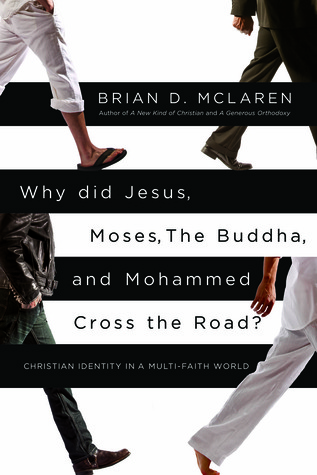
Why Did Jesus, Moses, the Buddah, and Mohammed Cross the Road? (Book Review)

13529088Reading a Brian D. McLaren book is very similar to eating an entire lemon marring pie by yourself: it’s sweet at times, troubling at others, a lot to take in and hard to finish. With that being said, his latest venture into disrupting the Christian status-quo, Why Did Jesus, Moses, the Buddah, and Mohammed Cross the Road, is most likely the best book on theology I’ve ever read.

I’m not saying I agreed with every sentence—or even understood every sentence—but I think McLaren appropriately tackles a giant issue usually ignored and commonly mishandled in the modern Church (that big C is on purpose).

So before I breakdown my review, I will just say: yes, go read this book. It will answer questions, ask even more questions, and cause you to examine, test, and filter your faith in ways you may never have wanted to—though desperately needed to.

Here’s the gist: 

-Friendships with personal agendas are not friendships. If we seek out people only to change them (or convert), then we are not loving missionaries but religious salesmen.

“Shouldn’t it be possible to have a strong Christian identity that is strongly benevolent toward people of other faiths, accepting them not in spite of the religion they love, but with the religion they love?”

-There are generally two views of a Christian multi-faith perspective (three if you include moderate in the middle): Weak/Benign or Strong/Hostile.

“Christians settle on the right side not because they want hostility but because they want a strong faith identity. Christians clutter on the left side not because they want weakness but because they don’t want hostility”

McLaren goes on to say that there could exist a new identity altogether, introducing the main theme of his book: a “Strong/Benevolent” identity.

-Instead of looking for ways to change other people in other religions, we should be healing the body of Christ first. If we are to look to other religions, it should be in ways of working together for the “common good.”

“…the choice to live not for our own selfish interests alone, and not for the groupish interests of our clan or caste or civilization alone, but for the common good, the good of all creation.”

The Good

McLaren doesn’t take the challenge lightly. All the research, arguments and counterarguments are incredibly arranged and well-written.

My favorite spot in the book was his reflection upon Christopher Columbus, Constantine, and the Crusades; how all these horrific figures and events changed the face of Christianity—from that of love to domination and oppression. In consequence, McLaren argues, other religions sprouted; not in opposition to Christ but to his followers and the bloodshed that followed them.

Another quick note was McLaren’s take on Christ himself. Though not demeaning his death and resurrection in any way, he states that if we frame our perspective differently, it will add more value to it.

Was Jesus’ death simply a substitution sacrifice for a bloodthirsty, limited god, or rather, the largest stance of peace on earth ever to be proclaimed, forever changing to fate of history and setting humanity free? (summarized from text).

The Bad

As I first mentioned, the book is a lot to take in. At times, it seems as if McLaren crammed as many cans of worms between the covers as he could find. Many topics are brought into the conversation only to be featured as a sentence, paragraph, footnote, or even chapter; though they add value, they are not fully explored. Some issues may have been better left out entirely instead of the surface depth exploration they were allotted. Some readers may enjoy that aspect, I found it distracting from the core theme.

Speaking of distraction, there are more footnotes than anyone reader could ever really do anything with. He puts them at the bottom of the page; since they are in view, I feel I must read them. By the time I finish with his branching thought, I forgot where I was earlier and get lost. So a little warning: stay away from the footnotes, or rather, at least pick and choose those that interest you.

They are books within books.

Overall

My perfect bible study would revolve around this text. Not because I agree with it all and only want to read what I want to read, but because I think it would be impossible to get enough people to agree on everything in it. And it would be a fun and rewarding challenge for those daring enough to take their faith outside the comfort zone.

And yes, we Christians need to change some things.

My final thought:

Don’t skip this book just because McLaren is labeled “emergent.” Mother Theresa is labeled “catholic,” though I’ve been hearing protestants quote her my whole life. Labels are just a way to keep people from learning from each other and from loving each other.

We’re all just men and women anyways.

Now go buy the book!

When God Rigs Football Games

There’s no doubt the word apartheid holds a certain a sting to it. Regardless, there are bits and pieces of existence in our world that require strong laws of separation, say: apple juice and chocolate milk, wine and liquor, George Clooney and Batman.

Many believe religion and politics are best kept apart. In fact, most would swear by that belief. I don’t hold strong opinions on that matter per say, though religion and sports, well, that is a separation I’m fond of.

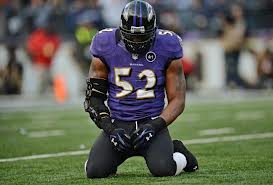
YES, sports. More so, the NFL. No, no, not Tebow. But more so Ray Lewis. 6a00d83451d77869e20147e051cf35970b-320wi

The 2012-2013 NFL season was a haven for Ray Lewis retirement talk; there’s no doubt that the Baltimore Ravens linebacker, who played seventeen seasons and finished with two championship rings, is one of the greatest. So yes, the NFL gave him a microphone throughout the season every chance they got.

And what happened? Ray gave the glory all to God, just about every time he spoke. Now that is pretty cool, I have to admit. It takes bravery, from any religion or faith, for a person to speak their heart in front of anyone. And in front of the entire world? Well that takes balls… footballs.

So what’s the problem?

Ray’s message of God culminated after his win at the Super Bowl, when he was on the podium in front of millions of people around the entire world and declared: “When God is with you, who can be against you?”

Well…

This comment stirred up a few things in me. To help process the good and the bad, I thought I’d make a good ol’ fashioned blog breakdown.

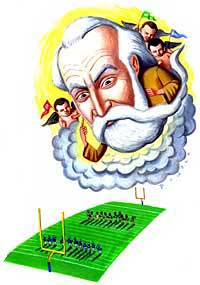
1. Does God Rig Football Games? This might sound ridiculous, though Ray Lewis is suggesting otherwise. The God of the universe, of Abraham, Isaac, and Joseph, breaks bookie bets? Is he a Baltimore fan or just more of an AFC guy? What does that say about the 49ers?

2Like the ancient greeks, are we creating our own gods? You could argue that Raw Lewis is not praying to Yahweh, but rather Mahweh: the God of Football Favor. I don’t say this to tear down the guy, like I said, I really do respect him. But we need to get serious about who we claim God is, and His mission. We take our eyes off the prize—of furthering the Kingdom through serving and loving others—and place them onto a football field. Personally, I may or may not have prayed to Fantweh: the God of Fantasy Football once or twice.

3. If someone earns a pedestal, can they say whatever they want? Yes. Definitely. There is a double standard here; I feel that if I were in Ray’s shoes, I would be doing the same thing, but instead protecting the rainforest or freeing enslaved children that harvest cacao for Hershey’s. My point is that when you earn your spot, your soapbox, you’ve earned the right to speak your mind even if you have no idea what you’re talking about. It’s up to the receiver to filter words and decide on the speaker’s expertise.

4. Maybe Ray is right. Does God love Ray Lewis more than any of the other player on any other team? I don’t know. It’s a possibility I guess. I don’t want to assume I know the details of God’s design. Though, if God was rooting for the Mr. Lewis, you would assume he’d be retiring with seventeen championship rings instead of two.

Maybe there is something larger at work than I know of. I could just be jealous that the Ravens cut me in the practice squad. (That never happened).

What I do know, is that it’s easy to quote scripture but harder to eat it. We need to be careful about who we claim God is and let God claim us. See, there are plenty of gods going around these days and if we’re not careful, we may latch on to something less than eternal, less than love.

Jesus & The Heart

When I was in the fifth grade, I accepted Jesus into my heart. By doing this, I didn’t have to change anything about my lifestyle; I just had to make room for God. The people who “saved” me went on with their lives, and I was left to figure out the complexities of becoming born again.

Roughly 13 years after becoming a Christian, I wonder if I easily received God into my life but not His will for my life. The more I read the Bible the more I have doubts about this phrase of accepting Jesus into my heart. (more…)